Arizona Paycheck Calculator
Estimate your Arizona take-home paycheck by entering your gross wages, frequency, and withholding settings. Applies the 2.50% flat income tax rate and 2026 federal brackets.
Estimated Take-Home Pay
per bi-weekly pay period
Detailed Deductions Breakdown
Evaluating an $80,000 Salary Under Arizona's Flat Tax System
If you are earning an $80,000 gross salary in Arizona, you are dealing with one of the most straightforward state tax setups in the country. Since the state transitioned to a flat-rate tax, calculating what you owe has become much simpler than in states with multi-tiered brackets.
For a single filer earning $80,000, your annual take-home pay will come out to roughly $63,513. On a standard bi-weekly schedule—meaning 26 paychecks a year—each check translates to a deposit of approximately $2,443 after federal withholdings, FICA, and Arizona's flat tax are taken out.
This paycheck total is calculated by subtracting your federal obligations (which you can estimate using our Federal Paycheck Calculator), FICA withholdings, and the flat state tax. Here is the math that governs this process:
To see how each paycheck is distributed per bi-weekly period:
- Gross Period Pay: $3,076.92 per paycheck
- Social Security Contribution (6.2%): $190.77
- Medicare Deduction (1.45%): $44.62
- Federal Withholding Tax: $337.31 ($8,770 annually)
- Arizona State Tax (2.50%): $61.44 ($1,597.50 annually)
- Total Period Withholdings: $634.14
- Your Net Check: $2,442.78
How the Flat State Tax Rates Benefit Taxpayers
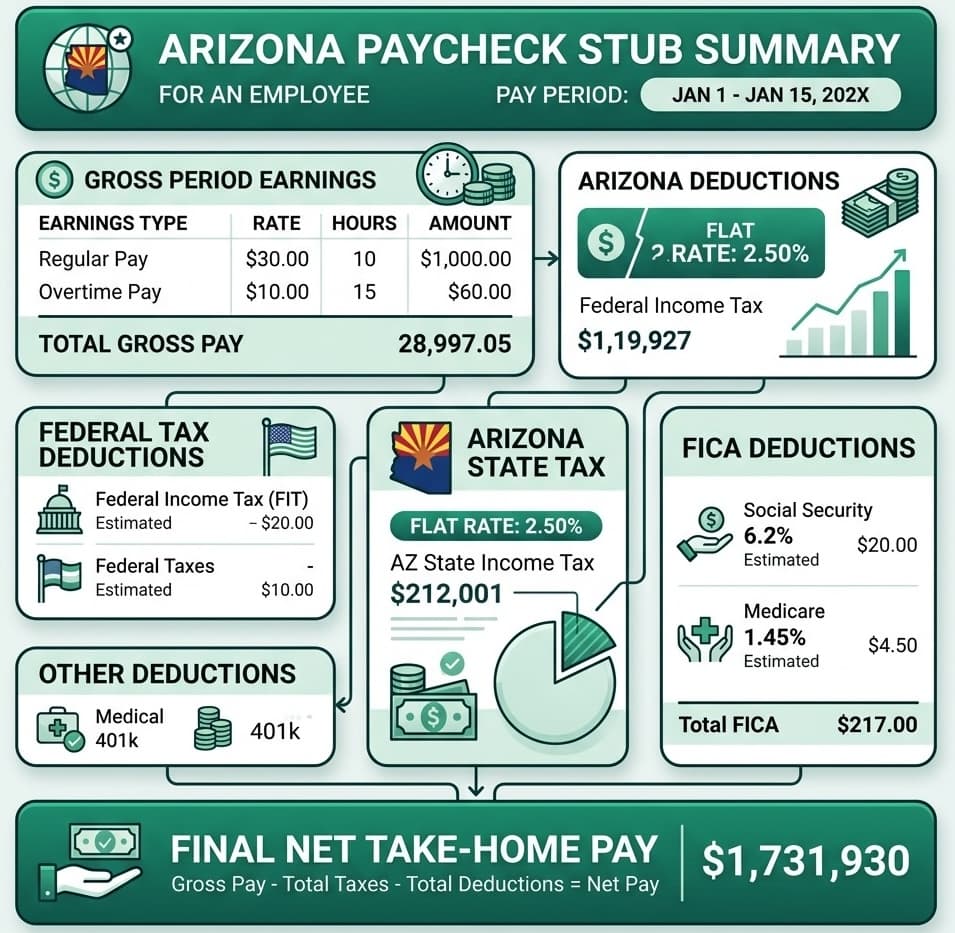
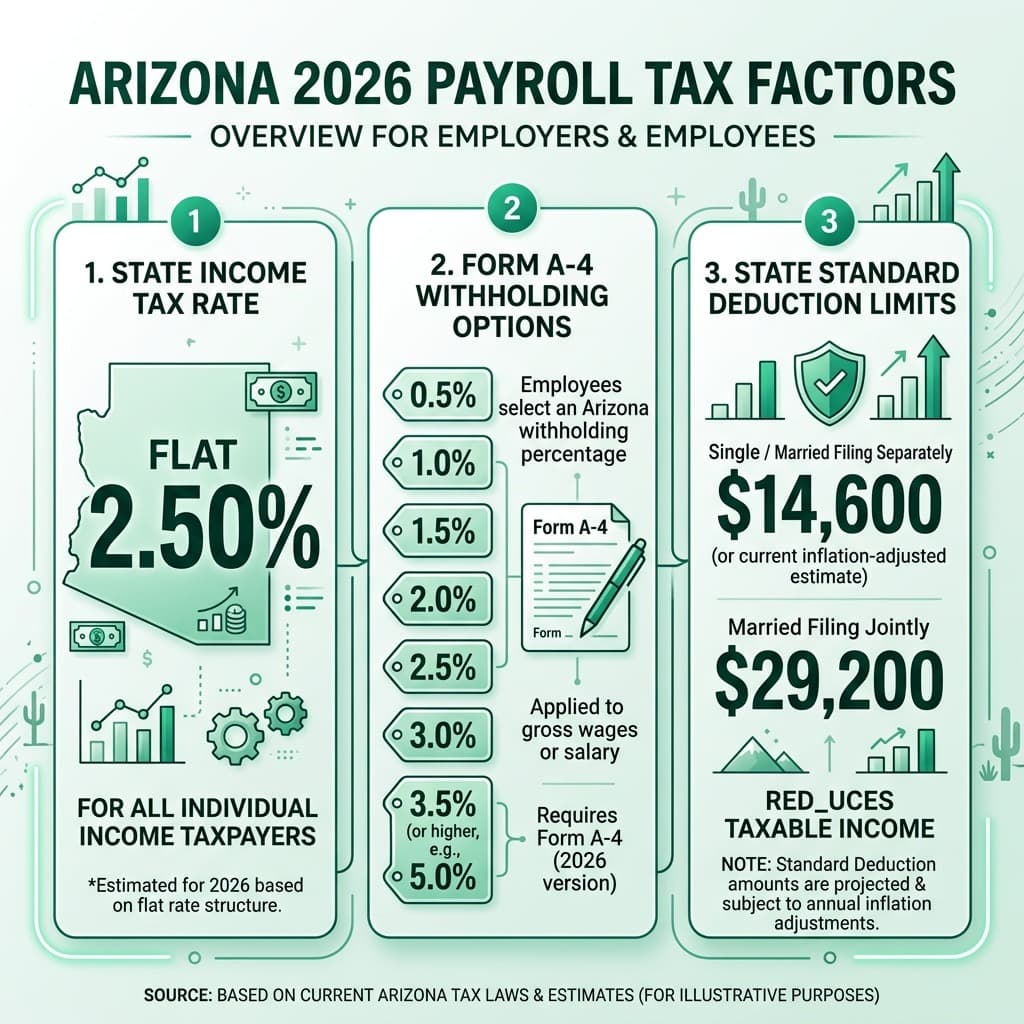
In 2023, Arizona completed its transition to a flat 2.50% state income tax rate. This replaced the old progressive system, which peaked at 4.5%. Now, every taxpayer—regardless of how much they make—pays the exact same percentage on their state-taxable income.
To prevent this flat rate from impacting lower-income workers disproportionately, Arizona conforms its state standard deductions directly to federal levels. For 2026, those standard deductions protect $16,100 for single filers, $23,625 for head of household, and $31,500 for married couples filing jointly. This is a very clean setup compared to states like Alabama, which phase deductions out as you make more money.
Form A-4: Selecting Your Custom Withholding Percentage
One of the most unique aspects of Arizona payroll is Form A-4 (Employee's Arizona Withholding Percentage Election). While federal taxes use standard allowances and marital brackets, Arizona asks you to choose a specific percentage of your gross taxable income to withhold from each paycheck.
Your options range from 0.5% up to 5.0% or more. If you choose not to turn in this form within five days of starting your job, your employer is legally required to withhold at the default rate of 2.0%. This forms the basis of the state calculations processed by the Arizona Department of Revenue.
Pros and Cons of the Arizona Tax System
Every state has financial trade-offs. Here is a realistic look at how Arizona's payroll taxes stack up:
The Advantages
- Flat 2.5% SIT: A highly competitive rate compared to states like California (up to 13.3%) or Arkansas (3.7% top marginal rate).
- Federal Conformance: Standard deductions match the IRS, shielding a significant chunk of income from state tax.
- No State Disability Tax: Arizona has zero employee-paid SDI or Paid Family Leave levies.
The Disadvantages
- No Federal Tax Shield: Unlike Alabama, you cannot write off your federal tax paid to reduce state taxes.
- Default 2.0% Withholding: If you forget to file Form A-4, you are forced into a default rate that might not match your actual liability.
- Sales Tax Burden: Flat state taxes are often offset by higher local county and municipal sales taxes.
How Your Benefits Lower What You Pay
If you pay for health insurance or put money into a traditional 401(k) through payroll, those pre-tax contributions lower your state taxable base.
Let's look at an example. If you earn a gross check of $3,000 ($78,000 annually), put 6% ($180) into a pre-tax retirement plan, and pay $100 for health premiums, your taxable check baseline is reduced to $2,720.
For state taxes, Arizona applies the flat 2.50% rate to your annualized base of $70,720 minus the Single standard deduction of $16,100. This leaves $54,620 in state-taxable wages, resulting in a bi-weekly state tax of $52.52.
For FICA, your health insurance premium of $100 is exempt, but your 401(k) contribution is not. FICA taxable wages evaluate to $2,900, yielding $179.80 for Social Security (6.2%) and $42.05 for Medicare (1.45%). Subtracting these, plus progressive federal taxes, leaves you with a net pay of $2,186.85.
Final Verdict: Who is This Calculator Best For?
This paycheck tool is ideal for anyone starting a new position in Phoenix, Tucson, or working remotely from Arizona. It is highly valuable for deciding which withholding percentage to select on your Form A-4.
Choosing the wrong rate can lead to underwithholding (resulting in an unexpected bill in April) or overwithholding (giving the state an interest-free loan). By running your expected earnings through this calculator, you can match your weekly budget with the best Form A-4 percentage for your personal tax situation.
Arizona Payroll Tax FAQs
Clear, expert answers to key questions about paycheck deductions and flat income tax rates in Arizona.
Other State Paycheck Calculators
Alabama Paycheck Calculator
Calculate take-home pay with Alabama state income tax brackets (2% - 5%) and federal tax deductibility.
Alaska Paycheck Calculator
Calculate payroll take-home pay in Alaska, which features zero state income tax and a 0.50% SUI deduction.
Arkansas Paycheck Calculator
Calculate take-home pay with Arkansas progressive tax brackets (0% - 3.7%) and Form AR4EC exemptions.
Colorado Paycheck Calculator
Estimate take-home earnings with Colorado's flat tax rate (4.40%) and 0.44% FAMLI deductions.