Alabama Paycheck Calculator
Estimate your Alabama take-home pay by adjusting for federal income taxes, state income tax, standard deductions, and city-level occupational taxes.
Estimated Take-Home Pay
per bi-weekly pay period
Detailed Deductions Breakdown
What a $70,000 Salary Actually Looks Like After Alabama Taxes
If you've negotiated a $70,000 annual salary in Alabama, the number on your offer letter is only half the story. After federal taxes, Social Security, Medicare, and state levies are deducted, your net take-home pay is roughly $55,144 per year.
Assuming you are paid on a standard bi-weekly schedule—which means 26 paychecks a year—each check will deposit approximately $2,121 into your bank account.
This final figure is calculated by taking your gross pay and subtracting federal income tax (which you can model with our Federal Paycheck Calculator), FICA withholdings, and Alabama's own state deductions. Here is the formula that governs this math:
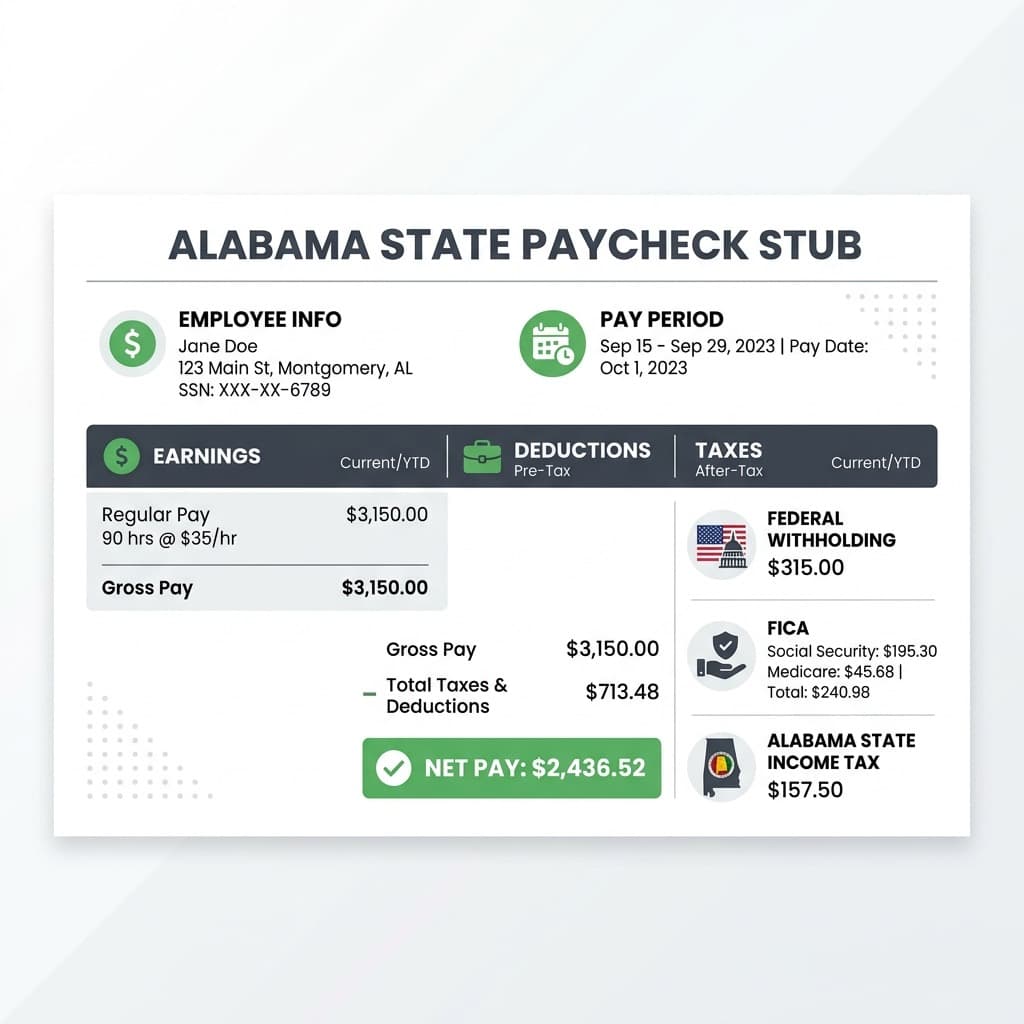
To see how each dollar of a $70,000 single salary is allocated during a single bi-weekly pay period:
- Gross Wages: $2,692.31 per pay period
- Social Security Contribution (6.2%): $166.92
- Medicare Deduction (1.45%): $39.04
- Federal Withholding Tax: $252.69 (translating to $6,570 over the year)
- Alabama State Income Tax (SIT): $112.75 ($2,932.50 annually)
- Total Period Withholdings: $571.40
- Actual Net Check: $2,120.91
The Federal Tax Shield: Alabama's Unique Deduction Rule
One of the most unusual features of Alabama's tax code is that it lets you deduct your federal income tax withholding directly from your state taxable income.
Think of this as a cushion against double taxation. Because you write off your federal payments on your state returns, a higher federal tax bill actually reduces the amount of income Alabama can tax. This federal tax shield keeps your state tax burden lighter than it would be in flat-tax states like Arizona or states with progressive systems that don't allow federal write-offs, such as Arkansas.
Understanding Alabama's Progressive Tax Brackets
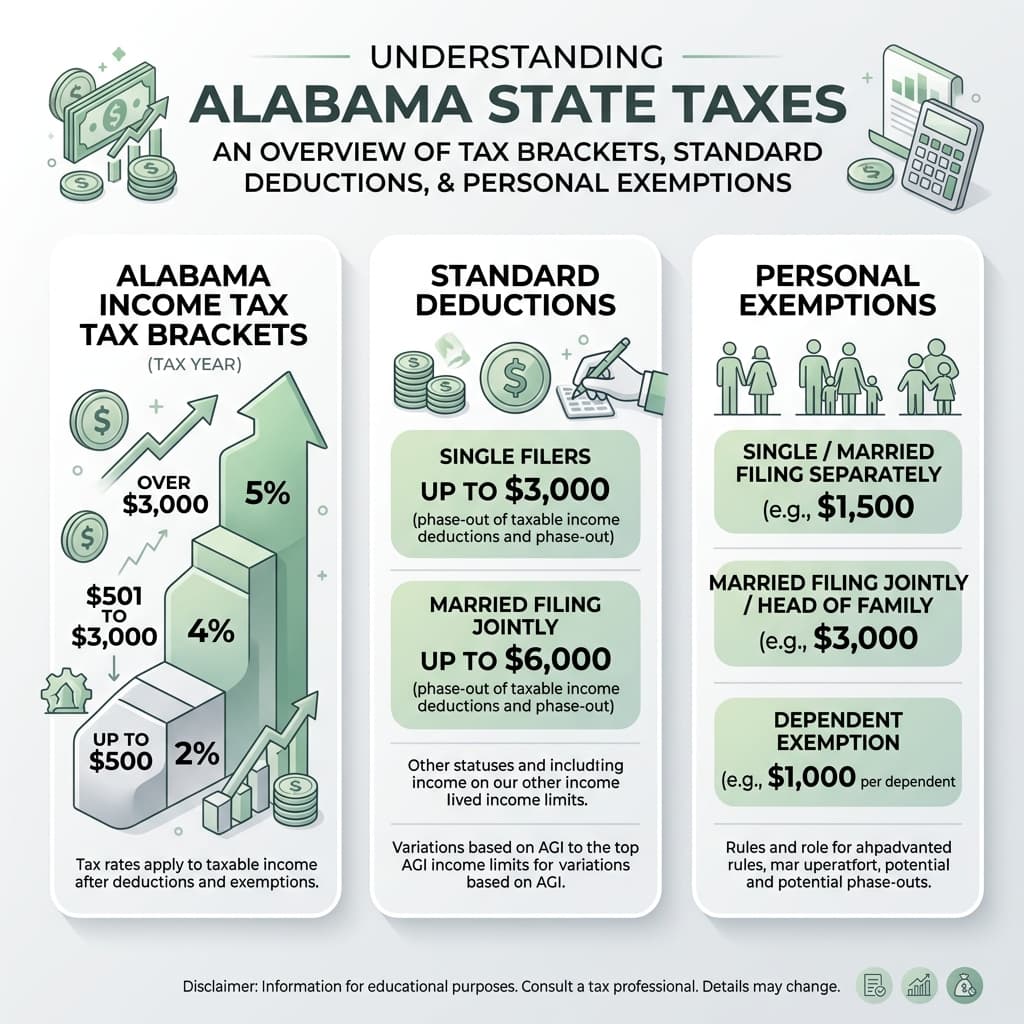
Alabama uses a progressive rate system with three tiers: 2%, 4%, and 5%. While it looks like a graduated structure on paper, the top 5% bracket kicks in at very low levels—just $3,000 of taxable income for single filers or $6,000 for married couples filing jointly. As a result, almost every full-time employee in the state ends up paying the top rate on their marginal earnings.
| Tax Rate | Single & Head of Family | Married Filing Jointly |
|---|---|---|
| 2% | Up to $500 | Up to $1,000 |
| 4% | $501 to $3,000 | $1,001 to $6,000 |
| 5% | Over $3,000 | Over $6,000 |
To prevent this low threshold from squeezing moderate-income workers, Alabama uses standard deductions and personal exemptions to shield some of your money. Every single filer gets a $1,500 personal exemption ($3,000 for married couples or heads of household). The standard deduction starts at $3,000 for single filers and phases down to a minimum of $2,500 once your gross income exceeds $33,000.
Watch Out for Municipal Occupational Taxes
If you work in Birmingham, Bessemer, Gadsden, or several other Alabama cities, your paycheck will likely reflect a local occupational tax. This flat 1% tax is deducted directly from your gross income.
Unlike federal and state income taxes, municipal occupational taxes are flat rates with no deductions, exemptions, or annual caps. They apply based on where your employer is physically located, not where you sleep at night. If you live in a suburb but commute to Birmingham, you still owe the tax. If you prefer a tax climate with zero local or state income taxes, you might compare these rates to states like Alaska or Colorado, where employee paycheck setups are structured differently.
Filling Out Your Alabama Form A-4
When you start a new job in Alabama, your employer will ask you to fill out Form A-4 (the state counterpart to the federal Form W-4) to determine how much state income tax to withhold. This is managed under the rules of the Alabama Department of Revenue.
This form is where you declare your filing status and claim allowances for any dependents. If you have multiple streams of income or feel you might owe money at tax time, you can also request a specific additional dollar withholding on this form. Keeping your Form A-4 updated ensures you don't end up with an unexpected tax bill when you file in April.
Alabama Paycheck Withholding FAQs
Clear, expert answers to key paycheck withholding, tax rate adjustment, and exemption questions.
Other State Paycheck Calculators
Alaska Paycheck Calculator
Calculate payroll take-home pay in Alaska, which features zero state income tax and a 0.50% SUI deduction.
Arizona Paycheck Calculator
Calculate take-home pay with Arizona's flat 2.50% state income tax rate and Form A-4 elections.
Arkansas Paycheck Calculator
Calculate take-home pay with Arkansas progressive tax brackets (0% - 3.7%) and Form AR4EC exemptions.
Colorado Paycheck Calculator
Estimate take-home earnings with Colorado's flat tax rate (4.40%) and 0.44% FAMLI deductions.