Alaska Paycheck Calculator
Calculate your exact Alaska net take-home pay. Account for federal tax withholdings, FICA deductions, and the unique Alaska employee state unemployment insurance (SUI) tax.
Estimated Take-Home Pay
per bi-weekly pay period
Detailed Deductions Breakdown
The Reality of a $105,000 Salary in the Last Frontier
Earning $105,000 a year in Alaska sounds like a ticket to keeping almost your entire paycheck. Because there is no state individual income tax, you avoid the heavy state levies that pinch workers in places like California or flat-tax states like Colorado.
However, your paystub still won't read a flat $105,000. Federal income taxes (which you can check on our Federal Paycheck Calculator), FICA withholdings, and a small state unemployment tax still claim a share of your paycheck.
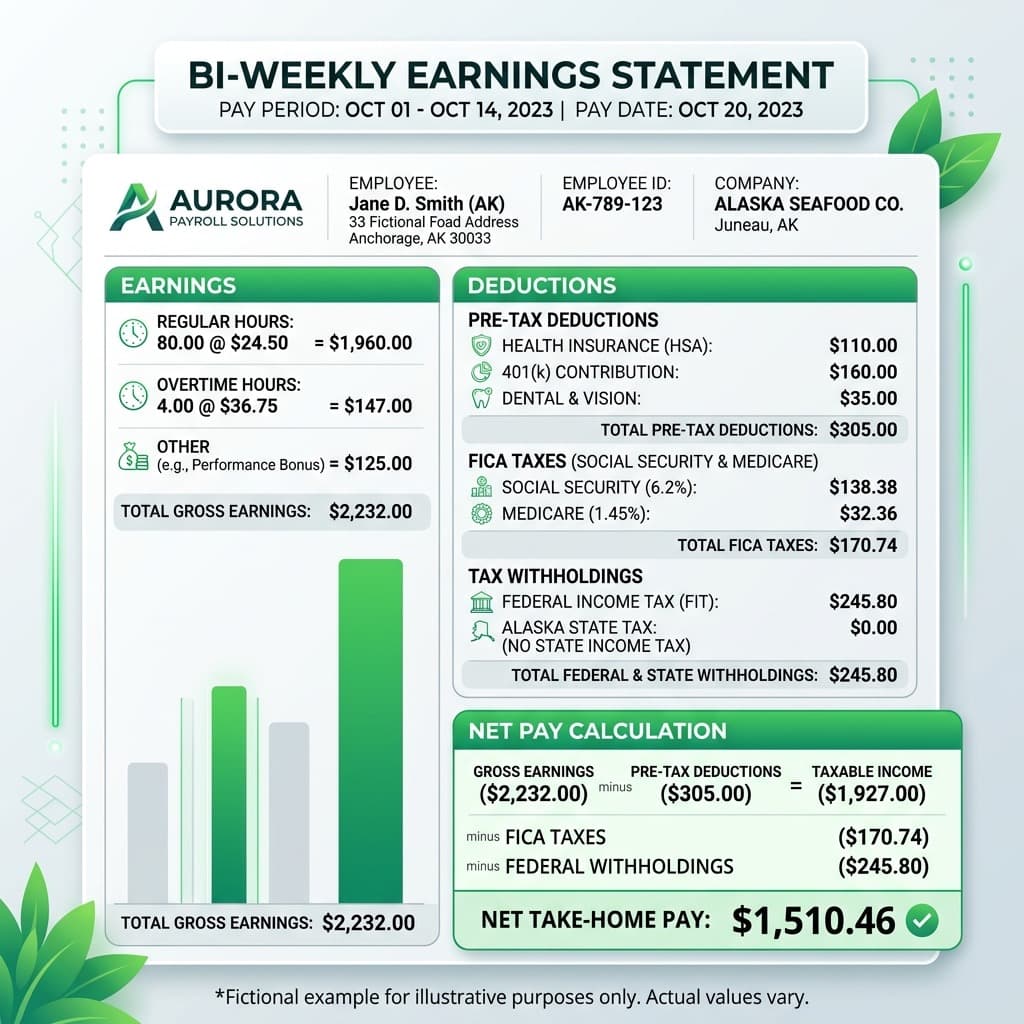
As a single filer on a standard bi-weekly pay cycle (26 paychecks per year), your net take-home check will settle at about $3,170. Annually, this means you take home roughly $82,427. Here is how that math breaks down per pay period:
- Gross Period Pay: $4,038.46 per check
- Social Security (6.2%): $250.38
- Medicare (1.45%): $58.56
- Federal Withholding: $548.85 (which adds up to $14,270.00 over the year)
- Alaska SUI Tax (0.50%): $10.42 (capped at $271.00 annually)
- Total Withholdings: $868.21
- Your Net Take-Home Check: $3,170.25
The Trade-Off: Zero Income Tax vs. Alaska's Employee SUI Tax
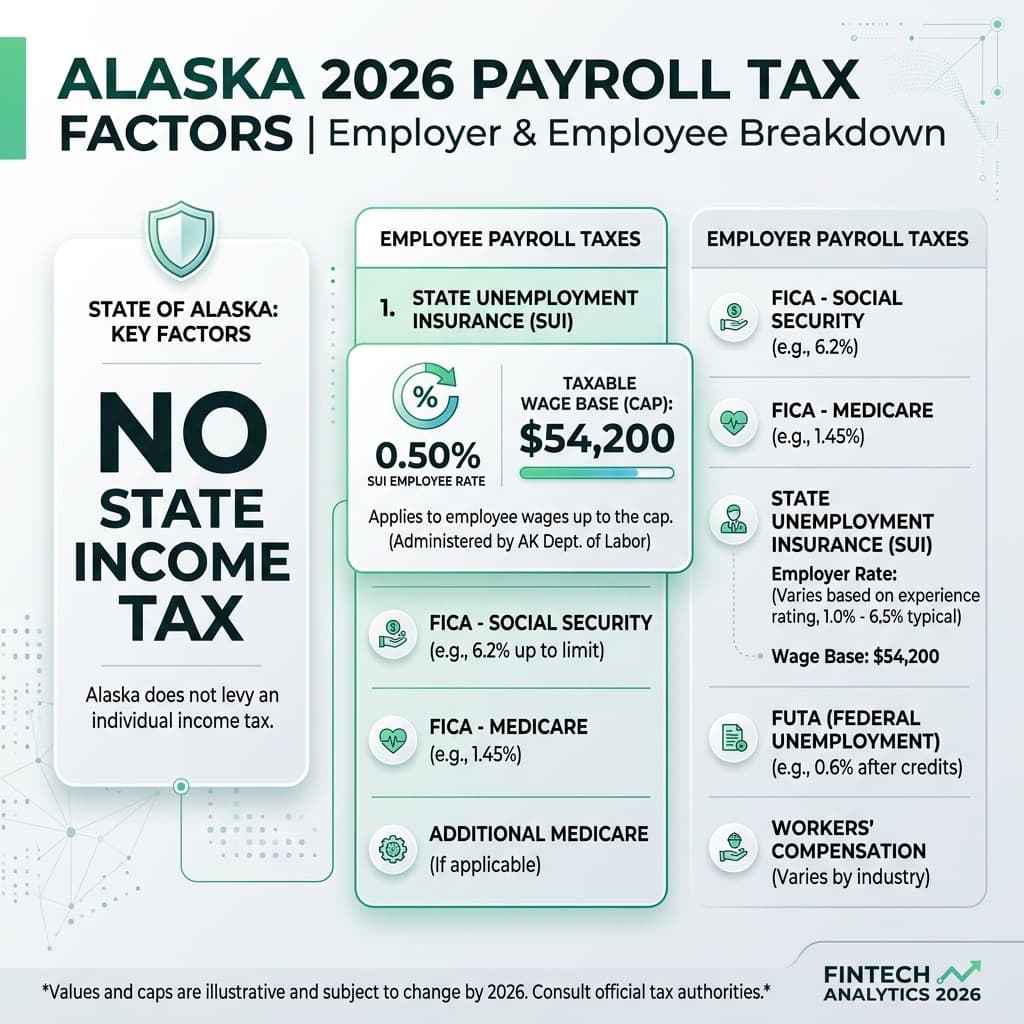
Alaska is one of the ultimate tax havens in the country, but it does have one specific payroll quirk. It is one of only three states—along side Pennsylvania and New Jersey—that requires employees to help fund the state's unemployment insurance program.
For 2026, the employee SUI rate is a flat 0.50%. The Alaska Department of Labor and Workforce Development sets a wage cap on this tax of $54,200.
Because of this cap, if you earn $105,000, you will only pay the 0.50% SUI tax on your first $54,200 of earnings. Once you hit that threshold—usually mid-year—your SUI withholding stops, and you will see your bi-weekly check rise by $10.42. Our paycheck calculator spreads this tax evenly across all 26 periods to keep your monthly budget estimates clean and predictable.
If you want to reduce this base even further, any pre-tax benefits you pay through payroll (like health premiums or traditional 401k contributions) are exempt from SUI under state statute, lowering the amount you contribute.
Remote Workers, Physical Presence, and the PFD
If you are a remote worker planning to move to Anchorage or Juneau to escape state taxes, you need to understand the residency rules. You cannot simply use an Alaska mailing address; you must establish physical domicile in the state to ensure your employer updates your state withholding designation.
Establishing residency also opens the door to Alaska's annual Permanent Fund Dividend (PFD). Funded by the state's oil investment revenue, the PFD pays a yearly dividend to qualified residents.
Keep in mind that the PFD is not a payroll benefit—your employer does not add it to your paycheck. It is distributed directly by the state government once a year and is subject to federal income tax, even though it avoids state-level taxes.
Pros and Cons of Working in Alaska
Understanding the true cost of working in Alaska requires weighing its tax benefits against its geographical realities:
The Advantages
- No State Income Tax: Keep a higher portion of your base salary.
- No Municipal Income Taxes: Cities and boroughs do not tack on occupational taxes.
- Permanent Fund Dividend: Receive an annual cash dividend from the state.
The Disadvantages
- High Cost of Living: Food, utilities, and housing are significantly higher than the national average.
- Employee-Paid SUI: A mandatory payroll deduction that most other US workers do not pay.
- Geographical Isolation: Travel costs and shipping delays are standard.
Final Verdict: Who is This Calculator Best For?
This tool is designed for remote professionals, contract workers, and new residents trying to visualize their actual take-home cash flow in Alaska. Because Alaska lacks standard progressive brackets, your federal tax choices on Form W-4 will be the main driver of your paycheck size.
By running your expected salary through this tool, you can see how much you will keep after federal withholdings and SUI, helping you budget accurately against Alaska's unique cost of living. If you are comparing offers in other low-tax states, you might also model check sizes in states like Arizona (flat 2.50% SIT) or Florida (0% SIT and no employee SUI) to see where your gross earnings stretch the furthest.
Alaska Payroll Tax FAQs
Clear, expert answers to key questions about paycheck deductions and SUI limits in Alaska.
Other State Paycheck Calculators
Alabama Paycheck Calculator
Calculate take-home pay with Alabama state income tax brackets (2% - 5%) and federal tax deductibility.
Arizona Paycheck Calculator
Calculate take-home pay with Arizona's flat 2.50% state income tax rate and Form A-4 elections.
Arkansas Paycheck Calculator
Calculate take-home pay with Arkansas progressive tax brackets (0% - 3.7%) and Form AR4EC exemptions.
Colorado Paycheck Calculator
Estimate take-home earnings with Colorado's flat tax rate (4.40%) and 0.44% FAMLI deductions.