Rhode Island Paycheck Calculator
Estimate your net take-home salary in Rhode Island. Enter your gross income, pay frequency, filing status, and pre-tax deductions to calculate federal income taxes, FICA, Rhode Island state taxes, and TDI contributions.
Estimated Take-Home Pay
per bi-weekly pay period
Detailed Deductions Breakdown
Rhode Island paycheck math: complete analysis of an $89,000 W-2 salary
In Rhode Island, a W-2 salary of $89,000 translates to $67,741.88 in net take-home pay each year, assuming a Single filing status and no pre-tax benefits. For workers on a bi-weekly payroll cycle, this delivers net deposits of $2,605.46 per paycheck, with state and federal withholdings combining to subtract $21,258.13 from gross annual earnings.
For federal taxes, FICA deductions subtract 6.2% for Social Security ($5,518.00) and 1.45% for Medicare ($1,290.50). Federal income tax (FIT) is calculated at $10,750.00, reflecting the standard $16,100 Single deduction. If you want to check national baseline taxes, our federal paycheck calculator can help model base withholdings.
For Rhode Island state taxes, the worker receives a standard deduction of $11,200 and one personal exemption of $5,250. This reduces taxable state income to $72,550. Since this amount falls entirely within RI's first progressive bracket, the state income tax is a flat 3.75%, totaling $2,720.63. Additionally, the employee must pay a 1.1% State Temporary Disability Insurance (TDI) contribution on their gross wages, which equals $979.00 annually.
| Tax Type | Annual Total | Bi-Weekly Paycheck |
|---|---|---|
| Gross Wages | $89,000.00 | $3,423.08 |
| Federal Income Tax | -$10,750.00 | -$413.46 |
| Social Security Tax (6.2%) | -$5,518.00 | -$212.23 |
| Medicare Tax (1.45%) | -$1,290.50 | -$49.63 |
| Rhode Island State Tax (SIT) | -$2,720.63 | -$104.64 |
| Rhode Island TDI Tax (1.1%) | -$979.00 | -$37.65 |
| Net Take-Home Pay | $67,741.88 | $2,605.46 |

Rhode Island's progressive tax brackets and linear phase-out rules
Rhode Island applies a progressive tax structure to all filing statuses. The three marginal tax brackets are 3.75% on taxable income up to $82,050, 4.75% on income between $82,050 and $186,450, and 5.99% on all taxable income exceeding $186,450.
To determine state taxable income, Rhode Island grants a standard deduction based on filing status: $11,200 for Single/MFS, $22,400 for Married Jointly, and $16,800 for Head of Household. Additionally, filers get a personal exemption of $5,250 per exemption allowance (Married couples get 2 allowances, or $10,500; Single and HoH get 1 allowance, or $5,250).
However, RI implements a strict phase-out system for high-income earners. If a taxpayer's state modified AGI exceeds $261,000, both their standard deduction and personal exemptions are reduced linearly. Once modified AGI reaches $290,800, both the standard deduction and exemptions are completely reduced to $0. You can review detailed regulations or check instructions directly on the Rhode Island Division of Taxation website.
The employee-funded Temporary Disability Insurance (TDI) program
Rhode Island is one of the few states that funds its short-term disability insurance entirely through employee payroll contributions. The TDI tax rate is set at 1.1%. This tax is assessed directly on the worker's gross wages up to a wage base cap of $100,000. This means the maximum annual TDI deduction for any Rhode Island worker is capped at $1,100.00.
Importantly, pre-tax deductions (like 401k retirement plans or section 125 medical insurance premiums) do not reduce gross wages for the purpose of the 1.1% TDI calculation. Workers must pay this tax on all gross wages up to the cap, regardless of their benefits enrollment.
How Pre-Tax Contributions and TDI Affect Rhode Island Salaries
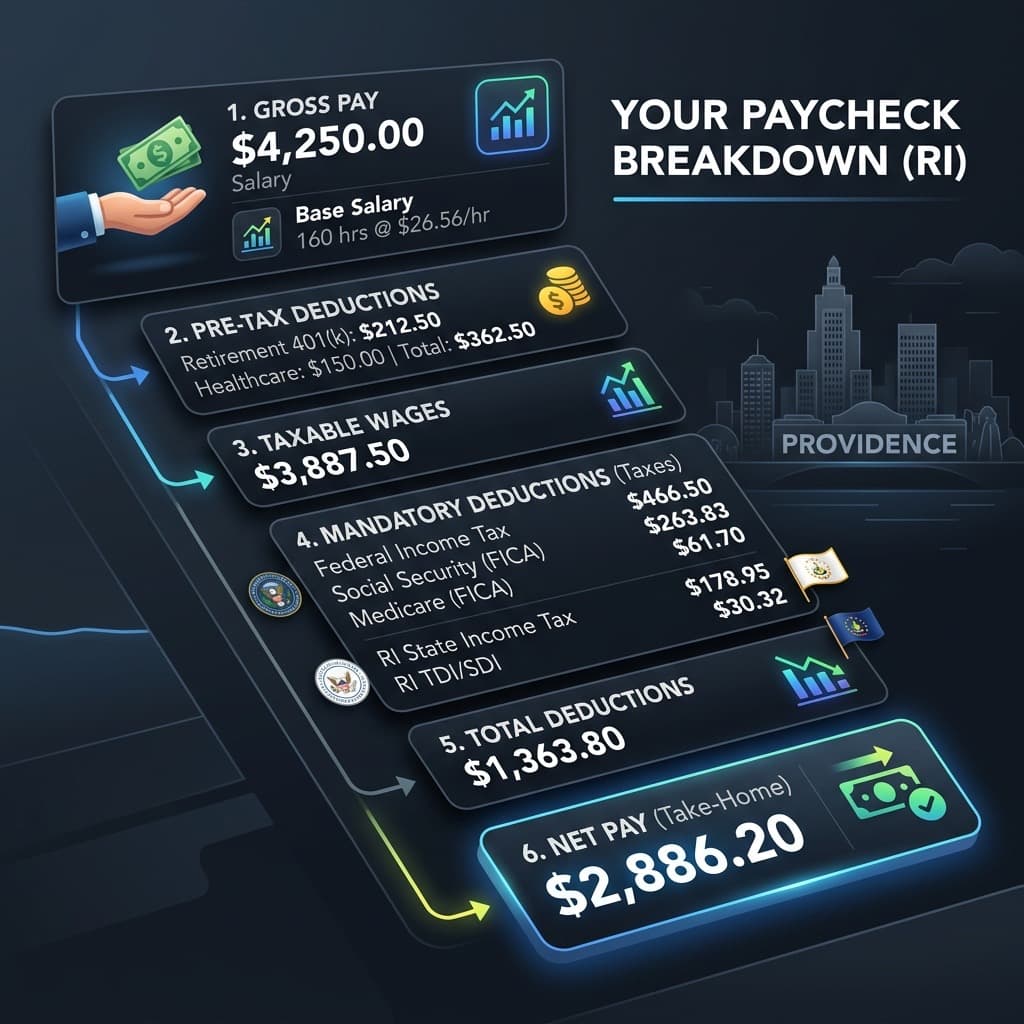
Contributing to pre-tax accounts can lower your state and federal taxes. Let's model a married couple in Rhode Island with a gross annual salary of $120,000. They choose to allocate 6% of gross pay to a traditional 401(k) retirement account ($7,200 annually) and contribute $150 bi-weekly for health insurance coverage ($3,900 annually).
FICA taxes are calculated on gross wages minus health insurance premiums, which yields a taxable FICA base of $116,100. This results in $7,198.20 for Social Security (6.2%) and $1,683.45 for Medicare (1.45%), totaling $8,881.65. Federal income tax (FIT) is calculated after subtracting both pre-tax benefits ($11,100) and the $32,200 Married standard deduction, leaving a federal taxable income of $76,700 and a tax of $8,708.00.
For Rhode Island SIT, the tax base starts with the pre-tax adjusted income of $108,900. Subtracting the state Married standard deduction ($22,400) and two personal exemptions ($10,500) leaves a state taxable income of $76,000. Since this falls within the 3.75% bracket, the state income tax is $2,850.00. Finally, because their gross wages exceed the TDI wage base limit of $100,000, they pay the maximum capped TDI contribution of $1,100.00.
This results in the following paycheck calculations:
- Gross Period Pay: $4,615.38
- Social Security (6.2% of FICA-taxable base): $276.85
- Medicare (1.45% of FICA-taxable base): $64.75
- Rhode Island State Income Tax (SIT): $109.62 (annualized to $2,850.00)
- Rhode Island TDI Tax: $42.31 (annualized to $1,100.00)
- Federal Income Tax withholding (FIT): $334.92 (annualized to $8,708.00)
- Total paycheck deductions: $1,255.37 (including pre-tax contributions and taxes)
- Net paycheck (Take-Home amount): $3,360.01
Summing all pre-tax benefits and mandatory tax withholdings, their total annual deductions reach $32,639.65. This leaves a net take-home salary of $87,360.35, which translates to a bi-weekly deposit of $3,360.01.
New England payroll comparison: Rhode Island vs. neighboring states
Working in Rhode Island comes with different tax structures compared to neighboring New England states. For instance, Connecticut to the west has progressive tax rates from 2.0% up to 6.99%, but does not levy an employee short-term disability tax. To the north, Massachusetts has a flat state income tax rate of 5.0% (plus a 4% surtax on income over $1 million), and charges a 0.46% employee contribution for Paid Family and Medical Leave (PFML).
Frequently Asked Questions (FAQs)
Other State Paycheck Calculators
Massachusetts Paycheck Calculator
Calculate take-home pay with Massachusetts' flat rate (5.0%) and standard deductions.
Connecticut Paycheck Calculator
Estimate take-home pay with Connecticut's graduated tax rates and CT Paid Leave.
New York Paycheck Calculator
Calculate take-home pay with New York's progressive tax brackets and local NYC taxes.
New Hampshire Paycheck Calculator
Calculate take-home pay in New Hampshire, featuring no state personal income tax on wages.