Pennsylvania Paycheck Calculator
Calculate your take-home pay instantly. Enter your hourly wages or annual salary, pay schedule, and filing status to see federal income taxes, FICA, flat Pennsylvania state taxes, and local EIT.
Estimated Take-Home Pay
per bi-weekly pay period
Detailed Deductions Breakdown
Pennsylvania paycheck math: breakdown on a $74,000 W-2 salary
An annual salary of $74,000 in the Keystone State leaves a W-2 worker with a net take-home pay of $58,565.40. This translates to a bi-weekly deposit of $2,252.51, reflecting $15,434.60 in total withholdings.
Unlike other states, PA has no progressive brackets and allows no standard deduction or personal exemptions. Your entire state income tax base is taxed at the flat state rate of 3.07%, which equals $2,271.80. Federal FICA taxes subtract 6.2% for Social Security ($4,588.00) and 1.45% for Medicare ($1,073.00). Federal income tax (FIT) totals $7,450.00, calculated after applying the $16,100 federal standard deduction. You can evaluate national baseline rates via our federal paycheck calculator to compare federal withholding brackets.
Additionally, Pennsylvania levies a State Unemployment Insurance (SUI) tax on employees. This tax is a flat 0.07% of gross wages, with no annual wage limit. For a $74,000 salary, this results in an annual deduction of $51.80.
| Tax Type | Annual Total | Bi-Weekly Paycheck |
|---|---|---|
| Gross Wages | $74,000.00 | $2,846.15 |
| Federal Income Tax | -$7,450.00 | -$286.54 |
| Social Security Tax (6.2%) | -$4,588.00 | -$176.46 |
| Medicare Tax (1.45%) | -$1,073.00 | -$41.27 |
| Pennsylvania State Tax (SIT) | -$2,271.80 | -$87.38 |
| Pennsylvania Employee SUI Tax | -$51.80 | -$1.99 |
| Net Take-Home Pay | $58,565.40 | $2,252.51 |
Understanding Pennsylvania's flat tax rate and zero deduction rules
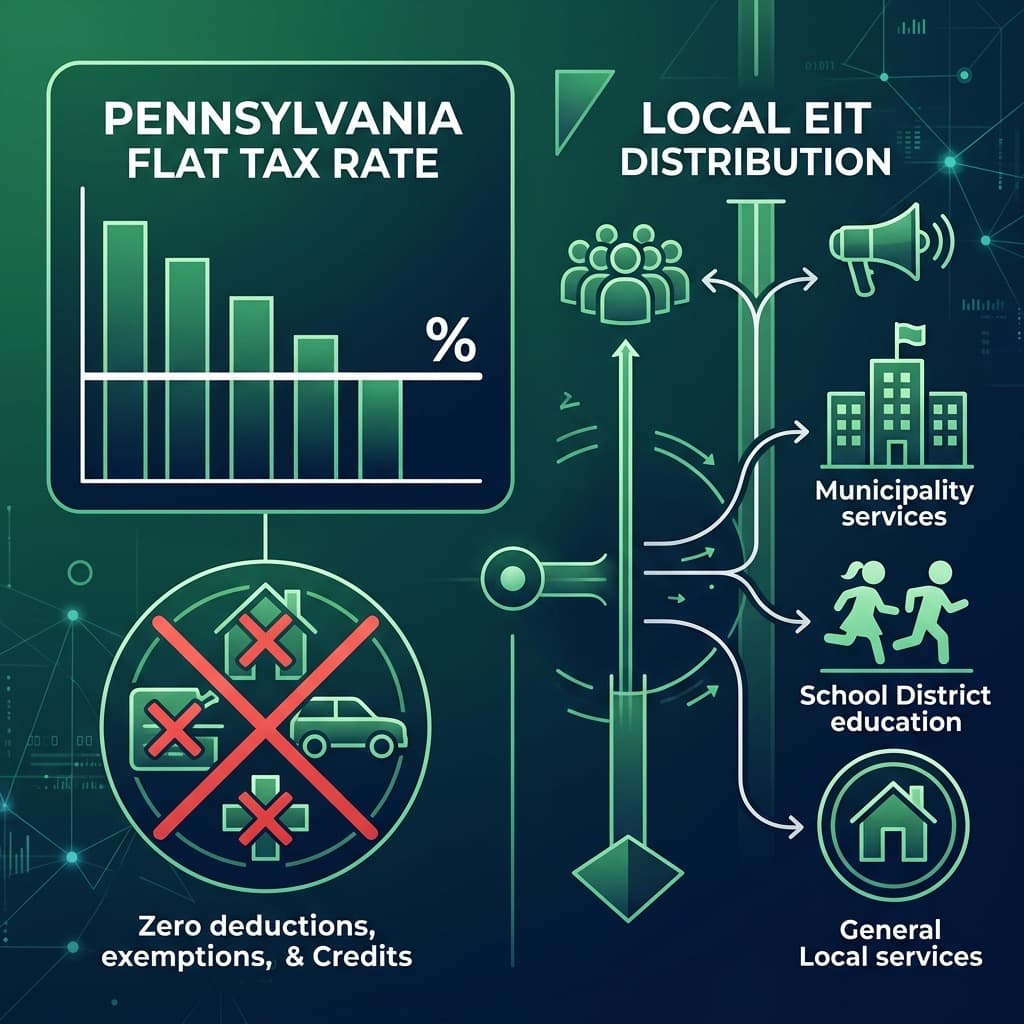
Pennsylvania's tax code stands out because it does not offer any standard deductions or personal exemptions. While most states offer a tax-free income threshold, PA taxes your first dollar of state taxable income at a flat 3.07%. This flat tax applies to all categories of income, including interest, dividends, and capital gains.
Since there are no state standard deductions, the only way to lower your PA state income tax is through pre-tax retirement plans (such as traditional 401k plans) or pre-tax health insurance premiums. Standard dependents do not reduce your state tax liability, although low-income filers may qualify for tax relief through the PA Tax Forgiveness program. For more information, check the official resources on the Pennsylvania Department of Revenue website.
Local Earned Income Tax (EIT) and Local Services Tax (LST)
Most PA municipalities and school districts levy a local Earned Income Tax (EIT). Local EIT rates typically range from 1.0% to 3.0%, with some cities charging more (e.g., Philadelphia charges over 3.75%). Employers must withhold the higher of your home resident EIT rate or your work location rate.
Additionally, workers are subject to the Local Services Tax (LST), which is a flat tax (usually $52 annually) used to fund municipal emergency services. If you earn less than $12,000 within a school district or municipality, you are exempt from paying the LST.

Calculating Take-Home Pay in PA with Pre-Tax Contributions
Pre-tax contributions have a major impact on your overall tax liabilities. Consider a married couple in Pennsylvania with a gross salary of $85,000. They decide to contribute 6% of gross pay to a traditional 401(k) plan ($5,100 annually) and pay $140 bi-weekly for health insurance ($3,640 annually).
FICA taxes are calculated on gross wages minus health insurance, resulting in a taxable base of $81,360. This results in $5,044.32 for Social Security and $1,179.72 for Medicare, totaling $6,224.04. Federal income tax (FIT) is calculated after subtracting both pre-tax benefits and the $32,200 Married standard deduction, yielding a taxable income of $44,060 and a final tax of $4,791.20.
Pennsylvania state income tax (SIT) is calculated after subtracting pre-tax retirement and health premiums, resulting in a state taxable base of $76,260. Since PA has no standard deductions, the flat 3.07% rate applies to this entire amount, resulting in a state tax of $2,341.18. Finally, the employee SUI tax applies to the full $85,000 gross wages, resulting in a flat 0.07% tax of $59.50.
This results in the following paycheck calculations:
- Gross Period Pay: $3,269.23
- Social Security (6.2% of FICA-taxable base): $194.01
- Medicare (1.45% of FICA-taxable base): $45.37
- Pennsylvania State Income Tax (SIT): $90.05 (annualized to $2,341.18)
- Pennsylvania Employee SUI Tax: $2.29 (annualized to $59.50)
- Federal Income Tax withholding (FIT): $184.28 (annualized to $4,791.20)
- Total paycheck deductions: $852.15 (including pre-tax contributions and taxes)
- Net paycheck (Take-Home amount): $2,417.08
After accounting for pre-tax allocations, FIT, FICA, SIT, and employee SUI, the final annual net take-home salary is $62,844.08, which is $2,417.08 bi-weekly.
Mid-Atlantic payroll climate: comparing PA with nearby states
Working in Pennsylvania comes with different tax considerations compared to neighboring states. For example, Ohio to the west has progressive tax rates up to 3.75% and levies local municipal taxes, but offers a $26,050 tax-free threshold. New York to the north has progressive tax brackets rising up to 10.9% and charges employee-paid family leave and disability premiums. New Jersey to the east has progressive rates up to 10.75% and charges state payroll taxes (SUI, TDI, and FLI) up to 0.845%. Maryland to the south has progressive rates up to 6.5% and a mandatory local income tax, but offers standard deductions and personal exemptions. Delaware to the southeast has progressive brackets up to 6.6%, which is higher than PA's flat rate.
Frequently Asked Questions (FAQs)
Other State Paycheck Calculators
New York Paycheck Calculator
Calculate take-home pay with New York's progressive tax brackets and local NYC taxes.
New Jersey Paycheck Calculator
Calculate take-home pay with New Jersey's progressive tax rates and SUI/FLI deductions.
Ohio Paycheck Calculator
Calculate take-home pay with Ohio's progressive income tax brackets and local school taxes.
Maryland Paycheck Calculator
Calculate take-home pay with Maryland's progressive rates and local county/city taxes.