New Jersey Paycheck Calculator
Calculate your net take-home salary instantly. Our tool accounts for federal income taxes, FICA withholdings, NJ state income taxes (SIT), and employee payroll deductions for SUI, TDI, and FLI.
Estimated Take-Home Pay
per bi-weekly pay period
Detailed Deductions Breakdown
Demystifying NJ paystub withholdings for an $88,000 salary
Negotiating a gross salary of $88,000 in New Jersey results in an annual take-home pay of $66,762.35. On a standard bi-weekly schedule, this translates to a direct deposit check of $2,567.78. Out of your total gross salary, the sum of $21,237.65 is withheld annually to meet federal, state, and local W-2 payroll obligations.
Your W-2 paycheck stub shows several layers of deductions. First, federal FICA taxes take 6.2% for Social Security ($5,456.00) and 1.45% for Medicare ($1,276.00). Next, progressive federal income tax is calculated at $10,530.00 (using the single standard deduction of $16,100). For state obligations, New Jersey state income tax (SIT) requires $3,415.65, which is determined after applying a standard $1,000 personal exemption to your gross pay. Finally, New Jersey's employee-funded payroll taxes for SUI, TDI, and FLI combine to subtract another $560.00. You can run these baseline rates on a federal paycheck calculator to check your national tax liability.
New Jersey paycheck distribution overview
Visualizing the withholdings on a $88,000 annual salary for a single taxpayer in New Jersey with no pre-tax benefits.
| Type of Withholding | Annual Total | Bi-Weekly Paycheck |
|---|---|---|
| Gross Earnings | $88,000.00 | $3,384.62 |
| Federal Income Tax | -$10,530.00 | -$405.00 |
| Social Security Tax (6.2%) | -$5,456.00 | -$209.85 |
| Medicare Tax (1.45%) | -$1,276.00 | -$49.08 |
| New Jersey State Income Tax (SIT) | -$3,415.65 | -$131.37 |
| NJ SUI / TDI / FLI Contributions | -$560.00 | -$21.54 |
| Net Take-Home Pay | $66,762.35 | $2,567.78 |
The mandatory employee-paid payroll taxes (SUI, TDI, and FLI)
W-2 workers in the state of New Jersey contribute directly to state social funds. These mandatory deductions are split into three programs and capped at specific wage limits annually.
The SUI/Workforce program charges 0.425% on the first $44,800 of wages, resulting in a maximum withholding of $190.40. The Temporary Disability (TDI) fund charges 0.19% on wages up to $171,100, which caps at $325.09. Finally, the Family Leave Insurance (FLI) program charges 0.23% on wages up to $171,100, capping at $393.53. These programs ensure workers have access to unemployment, short-term disability, and paid family leave benefits.
How New Jersey's progressive income tax brackets work
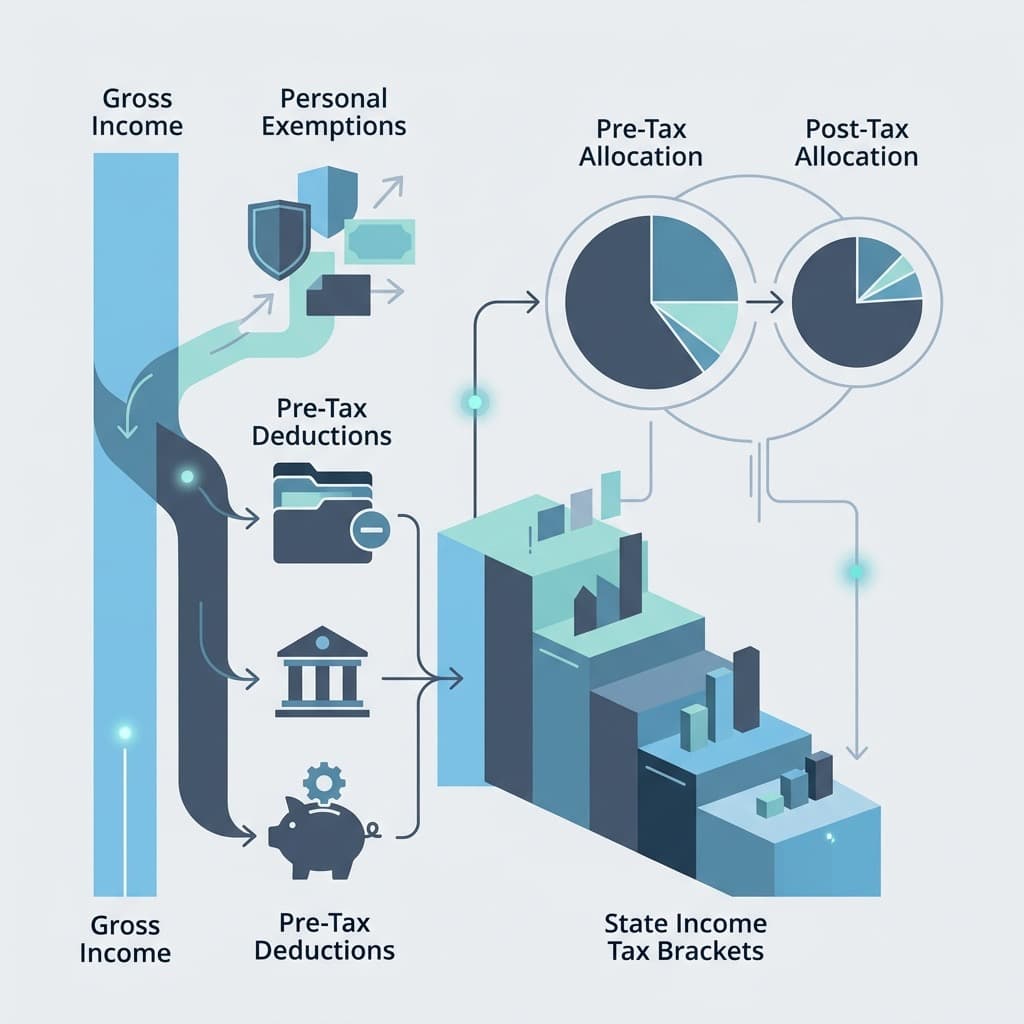
New Jersey applies a graduated tax rate to your taxable W-2 wages. For single filers, the progressive brackets start at a low rate of 1.4% on the first $20,000 of income. The rate increases to 1.75% for income up to $35,000, 3.5% up to $40,000, 5.525% up to $75,000, and 6.37% up to $500,000. For high earners, the rate reaches 8.97% up to $1,000,000, and a top marginal rate of 10.75% on taxable income over $1,000,000.
Personal exemptions versus standard deductions for Garden State filers
While the federal government uses a standard deduction to lower taxable income, NJ requires you to use personal exemptions. A single filer is allowed a standard personal exemption of $1,000. Married couples filing jointly receive a $2,000 personal exemption. These exemptions directly reduce your gross annual salary to establish your state taxable base. If you have additional dependents or qualify for senior/disability exemptions, you can claim further adjustments. For official guidelines, consult the New Jersey Division of Taxation website.
Why Section 125 health premiums are not pre-tax for NJ state tax calculations
Under NJ tax code, cafeteria plan contributions (such as health insurance premiums under Section 125) are not tax-deductible. While they lower your taxable income for federal tax and FICA calculations, they remain fully taxable for state income tax and state payroll taxes. Traditional 401(k) contributions, however, are fully exempt from state tax.
Bi-weekly pay check math for a $115,000 salary with retirement contributions
Consider a single employee earning a gross annual salary of $115,000 on a bi-weekly cycle ($4,423.08 per pay period). If they contribute 6% of their gross earnings to a traditional 401(k) ($265.38 per period) and pay $150.00 per paycheck for health insurance:
- FICA Taxable Base: $4,273.08 (Gross pay minus the $150 health premium).
- Federal Taxable Base: $4,007.69 (Gross pay minus both health and 401k deductions).
- NJ SIT Taxable Base: $4,157.69 (Gross pay minus only the 401k deduction).
This results in the following bi-weekly paycheck calculation for our $115,000 salary scenario:
- Gross Pay: $4,423.08
- Social Security Tax (6.2% of FICA base): $264.93
- Medicare Tax (1.45% of FICA base): $61.96
- Federal Income Tax (FIT): $542.08
- New Jersey State Income Tax (SIT): $180.62
- NJ Payroll Tax (SUI/TDI/FLI): $24.79
- Total Deductions: $1,489.76 (includes taxes, 401k contribution, and health premium)
- Net Take-Home Pay: $2,933.32

Comparing paycheck withholdings in NJ to Delaware and Connecticut
How your paycheck behaves in NJ compares differently with neighboring regional states in the Mid-Atlantic.
For instance, Delaware features progressive state income tax rates starting at 2.2% up to 6.6%, alongside a flat 0.40% PFML payroll withholding. Connecticut applies progressive tax rates ranging from 2.0% to 6.99%, plus a mandatory 0.50% employee-paid CT Paid Leave withholding.
While NJ has a higher top marginal tax rate, its progressive brackets start at a very low 1.4% base, providing competitive tax treatment for lower-to-middle income earners compared to states with higher flat rates.
Frequently Asked Questions on New Jersey Paycheck Withholding
Other State Paycheck Calculators
New York Paycheck Calculator
Calculate take-home pay with New York's progressive tax brackets and local NYC taxes.
Pennsylvania Paycheck Calculator
Estimate take-home pay with Pennsylvania's flat tax rate (3.07%) and local EIT taxes.
Delaware Paycheck Calculator
Calculate net pay with Delaware's progressive income tax and PFML deductions.
Connecticut Paycheck Calculator
Estimate take-home pay with Connecticut's graduated tax rates and CT Paid Leave.